
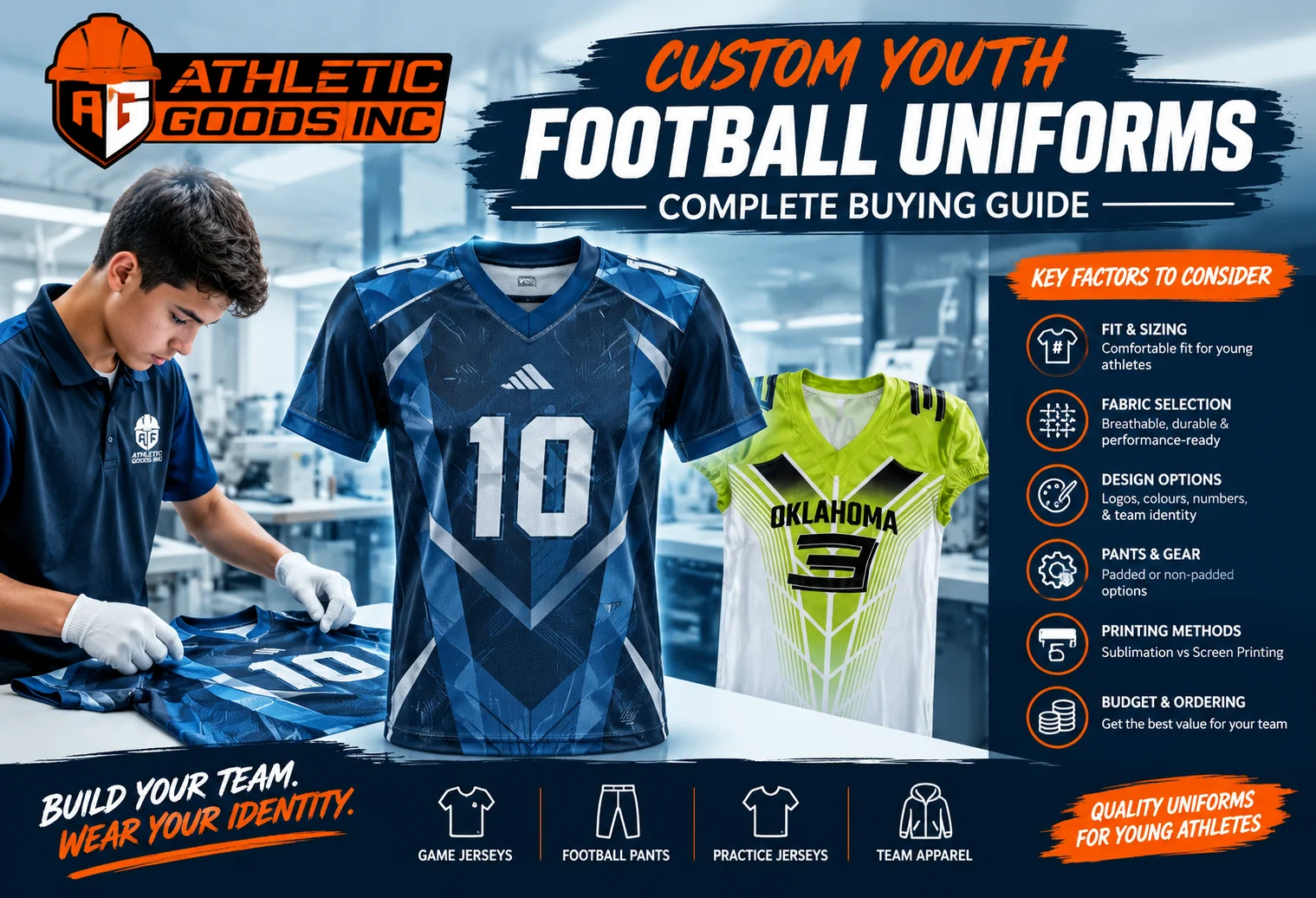
Youth football teams need uniforms that fit young athletes, support comfortable movement, and represent their team identity. Whether you manage a school team, community club, youth league, or football academy in Canada, choosing the right uniform involves more than picking colours and adding a logo.
From jersey sizing and fabric selection to player numbers, pants, design options, and ordering, every detail matters when preparing a team for the season.
This guide explains how to choose custom youth football uniforms, compare youth football uniform sets, plan a team design, and prepare an order with fewer avoidable mistakes.
What Are Custom Youth Football Uniforms?
Custom youth football uniforms are team garments designed around a club’s colours, logo, player numbers, and fit requirements. Unlike standard stock apparel, custom uniforms allow teams to create a coordinated appearance that reflects their identity.
A youth football uniform set may include:
- Game jersey: A team jersey with player numbers, colours, and logos.
- Football pants: Padded or non-padded options depending on the team’s equipment and league requirements.
- Practice jersey: A separate top for training sessions and drills.
- Team apparel: Optional warm-up tops, hoodies, or other clothing for travel and sideline use.
The exact kit depends on the age group, type of football, playing conditions, and team budget.
Who Should Consider Custom Youth Football Uniforms?
Custom uniforms can be useful for:
- Youth football clubs and community teams.
- School football programs and athletic departments.
- Football academies and training organisations.
- Coaches and team managers ordering for a full roster.
- Leagues coordinating uniforms across multiple teams.
For teams that want a consistent appearance across age groups, a shared design can help maintain a recognisable club identity while allowing each squad to have its own numbers or colour variations.
What Should a Youth Football Uniform Set Include?
Before choosing a design, decide which pieces your team needs. A complete kit is not necessarily the same for every youth football program.
Game Jerseys
The jersey is the most visible part of a team’s uniform. It usually carries the team logo, player number, and primary colours.
When comparing youth football team uniforms, consider:
- A fit suitable for the team’s equipment and playing format.
- Fabric that supports airflow and movement.
- Clear, readable player numbers.
- Comfortable seams and suitable construction.
- Colours that match the club’s identity.
For teams playing tackle football, confirm that the jersey accommodates the shoulder pads and follows the league’s uniform rules.
Football Pants
Football pants should suit the player’s equipment and the team’s style of play.
Some teams use pants with integrated padding, while others use shells designed to work with separate protective equipment. The appropriate option depends on the player’s equipment, age group, and league requirements.
Teams can explore and compare padded football pants with non-padded football pants when planning their kit.
Practice and Training Apparel
Practice apparel may include lightweight jerseys, training tops, and additional team clothing.
Separating practice wear from game-day uniforms can help teams manage laundry, reduce wear on match kits, and organise equipment across the season.
Home and Away Uniforms
Some teams require separate home and away jerseys to distinguish players from opponents.
Before ordering, confirm whether the league requires specific colours or contrast between teams. If two jersey versions are needed, include both in the budget and design plan.
How to Choose the Best Youth Football Uniforms
The best youth football uniforms are those that match the team’s needs, fit the players properly, and meet the requirements of the relevant competition.
Rather than selecting a kit based on appearance alone, review these factors before placing an order.
1. Choose the Right Fit for Young Players
Youth sizing is not always a simple scaled-down version of adult sizing. Players of the same age can have very different body measurements, and a roster may include a wide range of sizes. Before you collect measurements, it helps to go through an American football jersey sizing guide for youth and adult teams, so you know how player measurements translate into the right jersey size, especially when pads will be worn underneath.
A practical sizing process includes:
- Collecting individual player measurements.
- Comparing measurements with the supplier’s size chart.
- Checking jersey fit with the equipment players will wear.
- Reviewing waist and inseam measurements for pants.
- Confirming whether the fit allows comfortable movement.
Avoid choosing sizes based only on age or the size of a player’s everyday T-shirt. A jersey that looks right on its own can feel tight once shoulder pads are added.
2. Select Suitable Fabric
Football uniforms need to withstand regular use, movement, and repeated washing, so the material matters as much as the design. If you are unsure where to start, this look at the best fabric for American football jerseys explains how different materials perform in terms of airflow, durability, and comfort.
When reviewing fabric options, consider:
- Breathability: Helps support airflow during physical activity.
- Moisture management: Fabric designed to move moisture away from the skin may improve wearing comfort.
- Durability: Strong construction and suitable fabric can help garments withstand regular use.
- Weight: The fabric should suit the playing conditions and garment design.
- Care requirements: Check washing instructions before ordering.
Polyester-based performance fabrics are commonly used in sportswear because they can be lightweight and suitable for custom printing, which also makes them a good match for the sublimation option covered later in this guide.
3. Check Construction and Stitching
Uniform construction affects fit, appearance, and how garments hold up during repeated use.
Review the stitching around the shoulders, sleeves, side seams, and other high-movement areas. Ask the supplier about fabric specifications and construction details before approving a bulk order.
For tackle football, also check whether the jersey design is intended to fit over the team’s protective equipment.
4. Consider the Team’s Budget
Youth programs may have to work within school budgets, club funds, sponsorships, or parent contributions.
A practical budget should account for:
- Game jerseys and pants.
- Home and away sets, if required.
- Player names and numbers.
- Custom logos and design work.
- Shipping and applicable taxes.
- Spare uniforms or replacements.
- Optional practice and sideline apparel.
Compare the complete cost of the order rather than looking only at the price of one jersey.
How to Design Youth Football Uniforms
A strong design should represent the team while keeping player identification clear. You do not need an overly complicated layout to create a distinctive uniform.
When you design youth football uniforms, start with the team’s colours, logo, and competition requirements.
Step 1 — Choose Team Colours
Select a primary colour and one or two supporting colours.
For example, a team might use navy and white with a small gold accent. The colours should be consistent across jerseys, pants, and other team apparel.
Before finalising the palette, check whether the league has any colour or contrast requirements.
Step 2 — Add the Team Logo
The team logo helps identify the club or school.
Decide where the logo should appear, such as the chest or sleeve. Provide a clear, high-resolution file to the designer and confirm that the logo remains readable at the selected size.
If your team has multiple age groups, consider using the same logo placement across each uniform design.
Step 3 — Select Player Numbers and Names
Numbers should be easy to read from a distance and positioned consistently across the roster.
Before approving the artwork:
- Confirm every player’s number.
- Check the spelling of names.
- Review number size and placement.
- Verify league-specific rules.
- Check the contrast between numbers and jersey colours.
A roster spreadsheet can help the coach or team manager organise player details before production.
Step 4 — Choose a Design Style
Teams can choose from several visual styles depending on their identity.
Classic Football Uniforms
Classic designs often use solid colours, contrasting sleeves, and simple number layouts. They can suit school teams and clubs that prefer a traditional appearance.
Modern Custom Designs
Modern uniforms may use geometric patterns, gradients, contrasting panels, or more detailed graphics.
A modern design should still keep player numbers easy to identify.
Matching Club-Wide Designs
Clubs with several age groups can use a shared colour palette and logo while adjusting jersey details for each squad.
This creates a consistent identity without requiring every team to use an identical uniform.
Step 5 — Review the Digital Mockup
A youth football uniform designer can help turn the team’s ideas into a visual mockup before production.
Review the mockup for:
- Correct colours and logo placement.
- Player number visibility.
- Name spelling and number accuracy.
- Front, back, and side views.
- Matching jersey and pants designs.
- Any required sponsor or league details.
Ask for corrections before approving the final artwork.
Padded vs. Non-Padded Youth Football Pants
Football pants should be selected according to the equipment used by the team.
Padded Football Pants
Padded pants may include built-in padding in selected areas, depending on the product design.
Before choosing them, confirm:
- Which protective pads are included?
- Whether the design matches the team’s equipment requirements.
- How the pants fit with the player’s other gear.
- Whether the league permits the selected configuration.
Non-Padded Football Pants
Non-padded pants are designed without integrated protective pads and may be used with separate equipment, depending on the team’s setup.
Check whether the pants are compatible with the team’s pads and whether the fit allows players to move comfortably.
Important: Uniforms and apparel are not substitutes for properly fitted protective equipment. Coaches and parents should verify equipment requirements with the relevant league and qualified equipment personnel.
Sublimation vs. Screen Printing for Youth Football Jerseys
Choosing the right printing method helps youth teams create uniforms that match their colours, logos, and design preferences. Two common options are sublimation and screen printing. The right choice depends on the artwork, fabric, order quantity, and budget.
Sublimation Printing for Youth Football Jerseys
Sublimation printing uses heat to transfer a design into compatible synthetic fabric. It is commonly used for custom sportswear with detailed patterns and multiple colours.
Key features include:
- Detailed graphics and a wide range of colour combinations.
- Designs integrated into the fabric rather than forming a separate raised print layer.
- Suitability for all-over patterns and complex artwork.
When Should Youth Teams Choose Sublimation?
Sublimation may suit teams looking for custom youth football uniforms with detailed graphics, gradients, or multiple colours across the jersey.
What to Check Before Choosing Sublimation
Before selecting this method, confirm that the fabric is compatible with sublimation and that the final design meets the team’s requirements.
Design and Fabric Compatibility
Ask the supplier to confirm fabric composition, print quality, colour options, and how the artwork will appear on the finished jersey.
Screen Printing for Youth Football Jerseys
Screen printing applies ink to the fabric through a mesh screen. It may be suitable for simpler designs with fewer colours, depending on the garment and printing requirements.
When Should Youth Teams Choose Screen Printing?
Screen printing may work for teams that prefer straightforward graphics, such as a logo or number design, subject to the supplier’s available options.
What to Check Before Choosing Screen Printing
Review the available ink colours, print placement, fabric compatibility, and pricing for the team’s order quantity.
Comparing Printing Methods Before Ordering
Compare design complexity, fabric compatibility, expected use, and total cost before making a decision. For a more detailed comparison, read Sublimated vs. Screen Printed Football Jerseys: Which Is Better?
How Much Do Custom Youth Football Uniforms Cost?
The price of custom youth football uniforms depends on the design and the items included in the order. There is no single price that applies to every team.
Factors That Affect Uniform Pricing
Factor | How it can affect the cost |
Number of garments | Total quantity influences the overall order value and may affect unit pricing. |
Uniform type | Jerseys, pants, and complete sets have different costs. |
Customisation | Names, numbers, logos, and complex artwork can affect pricing. |
Fabric and construction | Material and garment specifications influence the final quote. |
Printing method | Printing requirements vary by design and production method. |
Shipping | Destination and shipping method affect the delivered cost. |
How to Plan a Youth Team Uniform Budget
Start by calculating the number of players and the items each player needs.
Then divide the order into essential and optional items:
- Essential: Game jerseys and required pants.
- Additional: Practice jerseys, spare garments, and sideline apparel.
- Optional: Extra warm-ups or other team merchandise.
Ask for an itemised quote that clearly identifies what is included. This makes it easier to compare suppliers and communicate costs to parents or club administrators.
How to Order Youth Football Uniforms
A structured ordering process helps reduce mistakes and keeps the team prepared for the season.
Step 1 — Confirm the Roster
Prepare a complete player list with:
- Player name.
- Jersey number.
- Jersey size.
- Pants size.
- Any approved personalisation.
Check the roster with the coach or team manager before submitting it.
Step 2 — Finalise the Uniform Requirements
Decide whether the team needs jerseys only, complete uniform sets, or separate game and practice apparel.
Confirm any league rules regarding colours, numbers, logos, and garment specifications.
Step 3 — Share the Design Brief
Send the supplier the team’s logo, colour preferences, design references, and personalisation details.
If the team already has a uniform design, provide the original artwork when available.
Step 4 — Review the Quote and Mockup
Before approving the order, confirm:
- Total quantity and size breakdown.
- Garments included in the package.
- Customisation details.
- Total price and shipping costs.
- Production and delivery estimates.
- Any sample or revision arrangements.
Step 5 — Approve the Final Order
Check all player names, numbers, sizes, colours, and artwork carefully.
Keep a copy of the approved design and final roster for future reference.
Step 6 — Inspect the Uniforms on Arrival
When the order arrives, compare the garments with the approved specifications.
Check the sizes, stitching, print placement, colours, and personalisation. Report any discrepancies to the supplier promptly.
How to Choose a Custom Youth Football Uniform Supplier
A supplier should be able to explain its product options, customisation process, sizing information, and ordering requirements clearly.
Questions to Ask Before Placing an Order
- What youth sizes are available?
- Can the order include different sizes within the same design?
- What fabrics and construction options are available?
- Can the team customize colours, logos, names, and numbers?
- Is a digital mockup available before production?
- What is the minimum order quantity, if any?
- What are the production and shipping estimates?
- What is the process for handling incorrect or damaged items?
- Can replacement uniforms be ordered later?
- Are there any additional charges for design changes or personalisation?
Getting clear answers helps the team understand the supplier’s process before committing to an order.
Why Choose Athletic Goods for Custom Youth Football Uniforms?
Athletic Goods provides custom football apparel for teams looking to coordinate their jerseys, pants, and team designs.
For youth programs, the ordering process should begin with the team’s requirements, including player sizes, uniform components, colours, and personalisation.
Teams can explore the following product options:
- Custom American Football Uniforms
- Custom American Football Jerseys
- 6-Panel Football Jerseys
- 12-Panel Football Jerseys
- Custom American Football Pants
Coaches and team managers should confirm available youth sizing, customisation options, order quantities, and delivery details directly with the supplier before placing an order.
Frequently Asked Questions
What should a youth football uniform set include?
A typical set includes a football jersey and pants. Depending on the team’s needs, it may also include practice apparel or additional team clothing.
How do I choose the right size for youth football uniforms?
Measure each player and compare the measurements with the supplier’s size chart. For tackle football, check the jersey fit over the player’s equipment.
Can youth football uniforms include player names and numbers?
Yes. Custom uniforms can include names and numbers when the supplier offers those options. Check the league’s rules before approving the design.
What fabric is commonly used for youth football jerseys?
Polyester-based performance fabrics are commonly used for sports jerseys. The best option depends on the garment design, playing conditions, and desired features.
Are padded or non-padded football pants better for youth teams?
The choice depends on the team’s equipment setup and league requirements. Confirm which pads are required and whether the pants are compatible with them.
Can a youth football team order different sizes in one order?
Many team uniform suppliers accommodate mixed-size orders, but availability and conditions vary. Confirm the size range and ordering requirements before submitting the roster.
How early should a team order custom football uniforms?
Start early enough to allow time for roster confirmation, sizing, design approval, production, shipping, and any necessary corrections. Ask the supplier for a timeline based on your season start date.
Can teams order matching uniforms for multiple age groups?
Yes. Teams can use a shared colour scheme and logo across age groups while adjusting sizes, numbers, and other details for each squad.
What should I check before approving a custom uniform design?
Review colours, logos, player names, numbers, garment sizes, and league requirements. Make sure the final mockup matches the team’s approved specifications.
How can I order custom youth football uniforms from Athletic Goods?
Start by reviewing the available football apparel, preparing your roster and design details, and contacting Athletic Goods to confirm sizing, customisation options, pricing, and delivery.
Final Thoughts
Choosing custom football uniforms for youth teams requires careful planning around fit, fabric, design, equipment, and budget.
A clear roster, suitable uniform components, readable numbers, and an approved design can help coaches and team managers organise a more consistent team kit.
Whether you are preparing a school squad, youth club, or football academy in Canada, start with the players’ needs and confirm the uniform requirements before placing your order.
Athletic Goods offers custom American football apparel options for teams planning their uniforms. Explore the available jersey and pants styles to begin planning your team’s kit.