
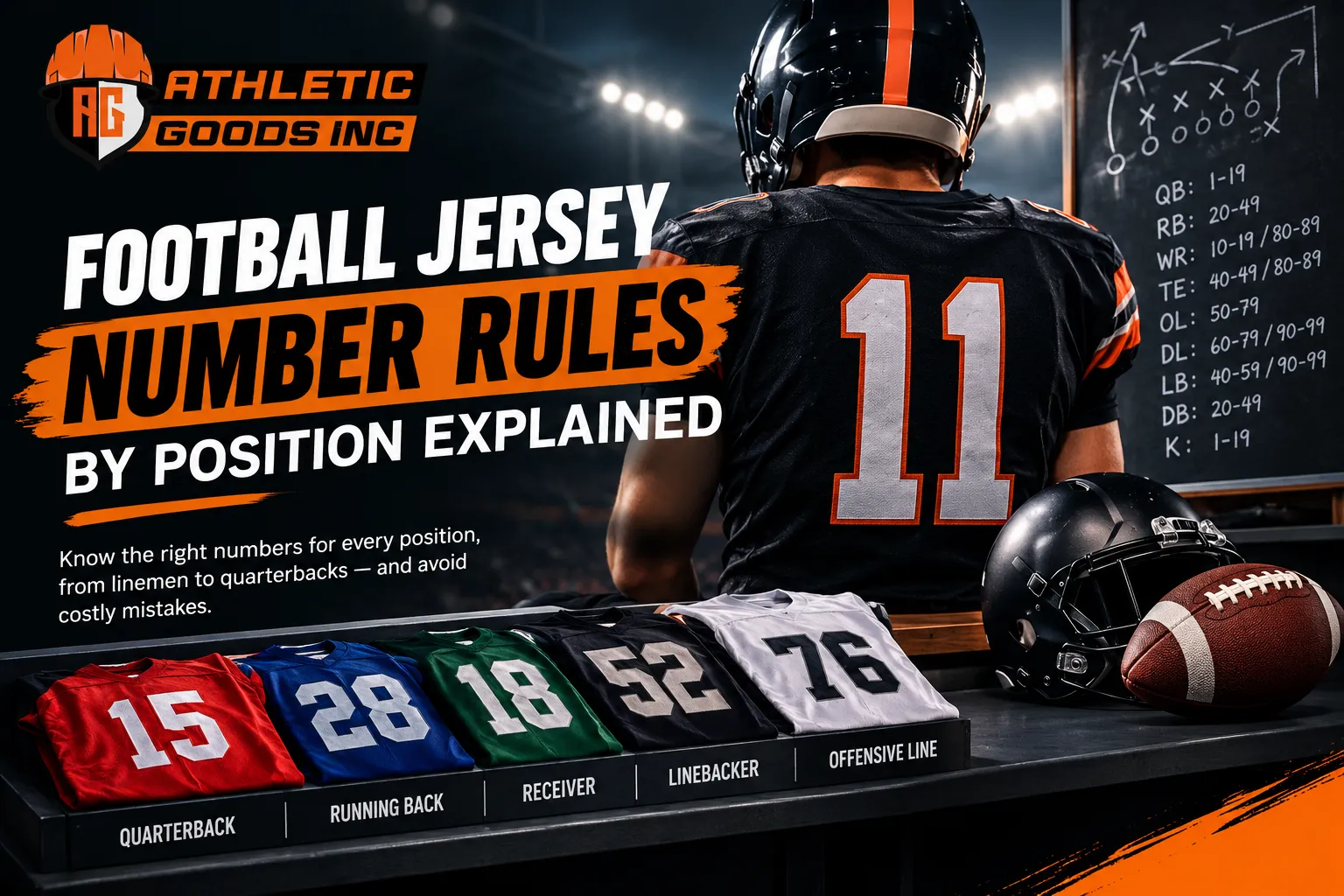
Assigning numbers looks simple until a lineman wants 32, a receiver asks for 55, and an official throws a flag on your first trick play. Football jersey number rules exist for a practical reason: officials use the number on a player’s chest to decide who may legally catch a forward pass. Get the numbering wrong and you can lose yards, a touchdown, or a full set of jerseys that has to be reprinted.
This guide explains football jersey numbers by position, how the rules change between professional, college, high school, Canadian and youth football, and how to turn those rules into a clean uniform order. It is written for coaches, team managers, athletic directors and anyone responsible for buying team uniforms. It covers gridiron football; if you are outfitting a soccer side, numbering works very differently, and our custom soccer uniforms page is the better starting point.
Why Football Jersey Number Rules Exist
In most sports, a number simply identifies a player. In football, it also signals what that player is allowed to do on offence. That is why football has stricter numbering conventions than basketball, hockey or soccer.
Numbers Separate Eligible and Ineligible Receivers
On every offensive snap, only some players may legally catch a forward pass. These eligible receivers are generally the backs and the players at each end of the line of scrimmage. Interior linemen are ineligible. Officials cannot read a playbook in the split second before the snap, so rulebooks tie eligibility to number ranges. In American football, players wearing 50 to 79 are generally treated as ineligible, while players with other numbers may be eligible depending on where they line up.
A pass caught by a player in an ineligible number, or a lineman drifting downfield on a pass play, can draw a penalty even when the play was designed that way. Correct numbering prevents those flags before they happen.
Numbers Help Everyone Follow the Game
Beyond eligibility, numbers let officials record penalties, coaches grade film, statisticians credit tackles and announcers identify players. A number that is legal but hard to read still causes problems, which is why number size, contrast and placement belong in the same conversation as number ranges.
Football Numbers by Position: The Traditional System
Most of what people mean by football positions numbers comes from the NFL’s long-standing numbering system, which shaped college, high school and youth habits for decades. Professional rules have loosened since 2021, but the traditional ranges remain the most widely recognized reference and a sensible default for amateur teams.
Quick Reference: Football Jersey Numbers by Position
Position | Traditional range | Notes |
Quarterback | 1–19 | Single digits and the teens remain the norm. |
Running back / fullback | 20–49 | Single digits are now common in many leagues. |
Wide receiver | 80–89, then 10–19 | Single digits are popular where allowed. |
Tight end | 80–89, then 40–49 | Needs an eligible number to catch passes without reporting. |
Offensive line (centre, guard, tackle) | 50–79 | The most tightly controlled range in every major code. |
Defensive line | 60–79, 90–99 | More flexibility than offensive linemen. |
Linebacker | 50–59, 90–99 | Many leagues now allow lower numbers. |
Defensive back | 20–49 | Single digits are increasingly common. |
Kicker / punter | 1–19 | Long snappers usually wear a lineman number. |
Treat this table as a traditional guide, not a universal rulebook. The binding rules come from your league, and the sections below explain where they differ.
Offensive Line Jersey Numbers (50–79)
Offensive line jersey numbers are the one area where almost every code agrees. Centres, guards and tackles wear numbers from 50 to 79. In American college and high school football, an offence must have at least five players numbered 50 to 79 on the line of scrimmage at the snap, with limited exceptions for scrimmage kick formations such as punts and field goals.
Why Linemen Are Locked Into These Numbers
Because officials use the 50–79 range to identify ineligible players, a lineman wearing 44 would look like a potential receiver. That confuses pass coverage, officiating and pass interference calls. Keeping linemen in a predictable range lets officials count the line at a glance.
Reporting as an Eligible Receiver
Many codes let a player wearing an ineligible number line up in an eligible position if he reports the change to the referee before the play. Teams use this for heavy formations, where an extra lineman lines up at tight end. Reporting rules, and whether they exist at all, vary between leagues, so confirm how yours works before you design plays around them.
What This Means for Youth and Two-Way Players
In youth and small-school football, the same player may play guard on offence, defensive end on defence and tight end on the goal-line package. Give that player a number that suits his primary offensive role. A 50–79 number works for a lineman who also plays defence, but a lineman number on a player who regularly catches passes will cause problems every week.
Skill Positions: Quarterbacks, Backs and Receivers
Quarterbacks, running backs, wide receivers and tight ends need eligible numbers, which in most American codes means anything outside 50 to 79. Within that range, the traditional groupings are habits rather than strict requirements in many leagues. A running back wearing 7 or a receiver wearing 2 is legal in most college and high school competitions today.
Defensive Players
Defensive numbering is usually more flexible because eligibility rules apply to the offence. Defensive linemen typically choose from the 50s through 70s and the 90s, linebackers from the 40s, 50s and 90s, and defensive backs from the 20s, 30s and single digits. Check your rulebook anyway: some youth and school leagues set defensive ranges to keep things simple.
Kickers, Punters and Long Snappers
Kickers and punters traditionally wear 1 to 19. Long snappers usually wear an offensive line number because they snap from the centre position. Some codes include a numbering exception for kicking formations, but the snapper still needs a number that fits the rules for scrimmage kicks.
How Football Jersey Number Rules Differ by League
Football jersey number rules are not identical everywhere. Before you approve a uniform order, confirm the current rulebook for the competition your team actually plays in, not the one you watch on television.
NFL: Looser Ranges Since 2021
The NFL relaxed its numbering rules in 2021, opening single-digit numbers to positions such as running backs, receivers, linebackers and defensive backs, and later expanded the use of 0. Offensive linemen remained restricted to 50–79. Because the league has changed these rules more than once, treat any published NFL range as subject to change, and do not assume professional rules apply to amateur play.
College Football (NCAA)
American college football ties eligibility directly to numbers. Players numbered 50 to 79 are ineligible receivers, and the five-player 50–79 requirement on the offensive line applies. Two players on the same team generally cannot wear the same number on the field at the same time, although duplicate numbers may exist on the roster.
High School Football in the United States
High school football in most U.S. states follows rules from the National Federation of State High School Associations (NFHS). These also require at least five offensive linemen numbered 50 to 79 on most plays and set minimum number sizes and contrast requirements for jerseys.
Canadian Football Codes
Canadian football is played with 12 players a side and uses its own rulebooks at the professional, university and amateur levels, with Football Canada and provincial associations governing most school and minor football. Canadian rules also link receiver eligibility to jersey numbers, but the ranges and exceptions are not always the same as in American codes. Teams playing Canadian football should check the current rulebook for their level and province before assigning numbers, especially when using uniform templates or roster sheets built around American conventions.
Youth and Flag Football
Minor football associations often adopt their parent body’s rules but may simplify them for younger age groups. Flag football leagues frequently have few or no position restrictions. Even when the rules are relaxed, using traditional ranges helps players learn the game and makes the step into tackle or school football easier. Our guide to custom youth American football uniforms covers other planning decisions for younger teams.
Football Jersey Numbers Meaning: Tradition vs Rulebook
Football player numbers explained simply come in two layers. The rule layer says which numbers are legal for which roles. The tradition layer explains why certain numbers feel right: quarterbacks in the teens and single digits, receivers in the 80s, pass rushers in the 90s.
Much of the football jersey numbers meaning that fans talk about is tradition, not regulation. A number becomes associated with a position because generations of players wore it there, and players often ask for the number of a player they admire. Many programs also retire or reserve numbers to honour former players or captains. These customs matter to team culture, but they should never override what your rulebook requires.
Handling Number Requests Fairly
When several players want the same number, set a simple policy before jerseys are ordered: seniority, returning players first, or a draw. Publishing the policy early avoids disputes during fitting day and keeps the roster sheet stable once production begins.
Football Uniform Numbers: Size, Placement and Readability
Once numbers are assigned, they still have to meet your league’s uniform rules. Requirements for football uniform numbers usually cover size, contrast and placement.
Minimum Number Heights
American college and high school rules generally require numbers at least 8 inches (about 20 cm) tall on the front of the jersey and at least 10 inches (about 25 cm) tall on the back. Canadian and youth codes may set their own minimums. Confirm the exact sizes with your league and share them with your supplier before artwork is finalized, especially for small youth sizes, where the available print area is limited.
Contrast and Number Style
Most codes require numbers in a colour that clearly contrasts with the jersey body. Thin outlines, gradients or busy patterns behind the digits can make a legal number hard to read on game day. Our custom American football uniforms guide explains how to check contrast at a distance, and sublimated vs screen printed football jerseys compares how each decoration method handles names and numbers.
Placement Beyond the Front and Back
Front and back numbers are standard. Sleeve or shoulder numbers are common and help officials, coaches filming from the press box and camera operators identify players from the side, but whether they are required depends on the league. Helmet numbers are a team choice in many programs. Decide on optional placements before you request a quote so every jersey in the order matches.
Do Practice Jerseys Need Numbers?
Most numbering rules apply to game uniforms, so practice jerseys give teams more freedom. Many programs still number practice tops because it makes film review, drill rotations and depth-chart tracking far easier. Others use colour-coded practice jerseys by unit, such as offence, defence and scout team, with or without numbers.
If you number practice jerseys, using each player’s game number keeps film and stat tracking consistent. If players move between units, unnumbered or reversible practice tops can be more practical. Our guide to football practice jerseys vs game jerseys for teams compares construction, durability and budget considerations for both.
How to Plan Football Positions and Numbers for a Team Order
Numbering decisions affect how many jerseys you order, in which sizes and with which numbers. Settling football positions and numbers before production prevents the most common reprint problems.
Build the Roster by Position First
List every player by primary position, then assign numbers from the legal range for that position. Make sure there are enough 50–79 numbers for every offensive lineman and long snapper, including backups. Record each player’s number alongside jersey size; our American football jersey size guide explains how to measure players for a fit over shoulder pads.
Use a Number Planning Worksheet
A single shared worksheet keeps the coaching staff, equipment manager and supplier working from the same information. A simple version might look like this:
Player | Primary position | Number | Jersey size | Home / away | Notes |
Player A | Centre | 55 | Adult XL | Both | Also long snapper |
Player B | Wide receiver | 11 | Adult M | Both | Number previously retired? Check |
Player C | Linebacker | 44 | Adult L | Both | Two-way: fullback |
Spare | — | Blank | Adult L | Home | Mid-season addition |
Leave Room for Growth and Late Additions
Hold back a few numbers in each range, especially 50–79, for players who join after the order is placed. Youth programs should also expect players to change positions as they grow, which may mean a new number the following season.
Reserve Numbers for Call-Ups and Shared Jerseys
Clubs that move players between age groups or share uniform sets across levels should keep a list of numbers already in use at each level. That prevents two players in the same number from dressing for the same game.
Avoid Duplicate Numbers on the Field
Large rosters and programs that share jerseys sometimes duplicate numbers. Where your rules allow this, make sure the two players never take the field together, including on special teams units such as kickoff and punt coverage.
Keep Home and Away Sets Matched
Each player should wear the same number in home and away jerseys. Use one master roster for both sets so font, size and placement stay consistent across colourways. Once the roster is final, our step-by-step guide to ordering custom team uniforms walks through quotes, proofs and approvals.
Order Spares and Plan for Next Season
Torn jerseys, late additions and growing players all create replacement needs. Ask your supplier whether spare jerseys can be ordered blank or numbered later, and keep your approved artwork and number style on file so reorders match the original set.
Keeping Numbers Legal and Readable All Season
A number that was legal on delivery day can become a problem by playoffs if it fades, cracks or peels. Care habits protect both the look of the uniform and its compliance with contrast rules.
Wash and Dry With the Decoration in Mind
Follow the supplier’s care label first. General teamwear practice is to turn jerseys inside out, wash in cool water with a mild detergent, avoid bleach and fabric softener, and air dry rather than tumble dry on high heat. Separate dark and light jerseys, particularly after the first few washes. For sublimated uniforms, our guide on how to wash sublimated jerseys without fading them covers the details.
Inspect Numbers Between Games
Check jerseys after games for lifting edges, cracking or contrast loss on the numbers, and set aside damaged jerseys before the next game rather than on game day. Replacing one jersey early is easier than explaining a hard-to-read number to an official.
Common Football Numbering Mistakes to Avoid
Copying Professional Rules
NFL ranges are not your league’s ranges. Always check the rulebook for your level of play.
Running Out of Lineman Numbers
Teams often order too few 50–79 jerseys and end up with backup linemen in illegal numbers. Count every lineman and long snapper, including depth players.
Approving Artwork Before Numbers Are Final
Changing numbers after proof approval can delay production or add cost. Finalize the roster and number list first, then approve artwork.
Choosing Style Over Readability
Decorative fonts, thin outlines and low-contrast colours may look good on screen but fail on the field. Test the design at a distance before signing off.
Ordering Numbered Football Uniforms From Athletic Goods
Athletic Goods supplies custom American football jerseys for Canadian schools, clubs and teams, with team colours, logos, names and numbers built into the design. Bring your completed roster sheet with positions, numbers and sizes, along with any league requirements for number size or placement. When everything is ready, you can request a quote with your quantities and artwork.
Frequently Asked Questions
Can two players on the same football team wear the same number?
In many codes, yes, but they cannot be on the field at the same time. College and high school rules generally prohibit teammates with identical numbers from playing in the same down. Check your league’s rules before issuing duplicate numbers.
Can a football player wear number 0?
It depends on the league. The NFL has allowed 0 for some positions in recent seasons, while amateur codes differ. Confirm with your rulebook before ordering a jersey with 0 or 00.
What numbers can offensive linemen wear in football?
In most American codes, offensive linemen wear 50 to 79, and college and high school rules require at least five players in that range on the line at the snap. Canadian codes have their own ranges, so check your provincial rulebook.
Do football positions and numbers have to match in youth football?
Not always. Some minor and flag leagues relax position ranges for younger players, but many associations still require linemen to wear lineman numbers in tackle football. Check the rules for each age group.
Can a player change jersey numbers during the season?
Usually yes, as long as the new number is legal for the position and not already in use. Most leagues expect roster updates before the game, so keep spare jerseys available.
Are football jersey number rules the same in Canada and the United States?
Not exactly. Both link receiver eligibility to numbers, but Canadian football follows its own rulebooks. Canadian teams should follow their provincial association or governing body rather than U.S. high school or NFL guidance.
Get Your Numbers Right Before Production
The safest order of operations is simple: confirm your league’s current football jersey number rules, assign every player a legal number by position, check the minimum number sizes, then approve your uniform artwork. Settling these details first protects your team from penalties and your budget from reprints.